
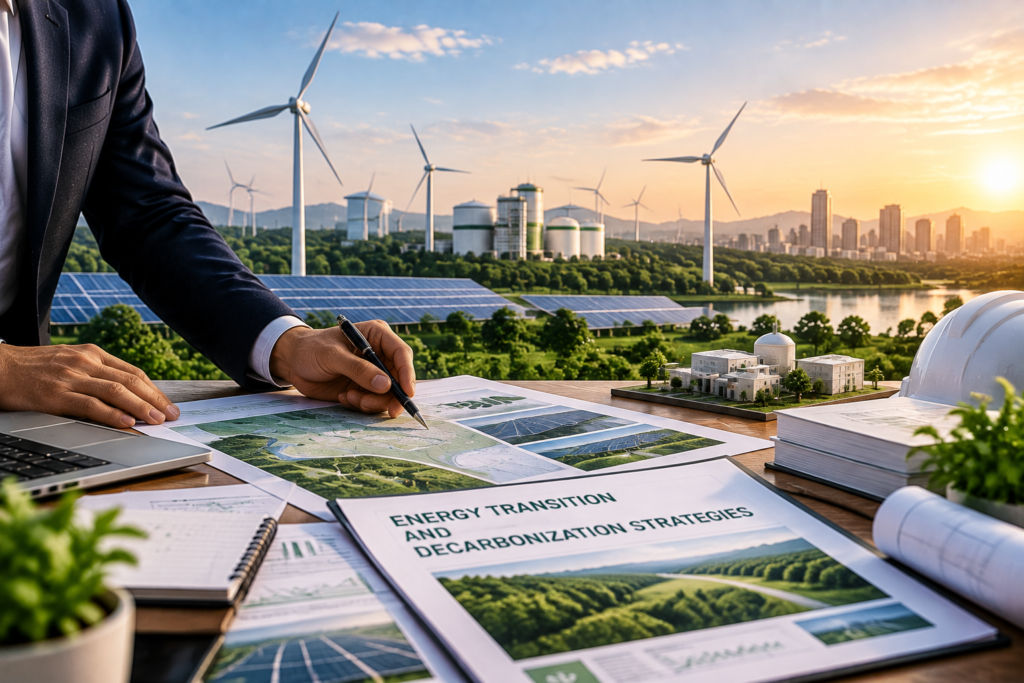

The shift towards cleaner energy is changing how businesses generate power, operate facilities, invest in infrastructure, and plan for long-term growth.
For organisations with significant energy use or carbon emissions, the challenge is not simply deciding to “go green.” The real questions are more practical:
Where are our emissions coming from? What can we realistically reduce? Which technologies make sense? How much will the transition require? And where should we start?
Our Energy Transition & Decarbonization Strategy services help organisations answer these questions and build a realistic pathway towards a lower-carbon future — without losing sight of cost, reliability, operations, and business priorities.
Decarbonization Is a Business Transition, Not a Single Project
Installing solar panels or purchasing renewable power can be valuable, but meaningful decarbonization often requires a broader view.
Energy use may be connected to electricity, heating, industrial processes, transportation, buildings, equipment, supply chains, and other operational activities.
We look at the complete picture to understand where change can create the greatest impact and which actions are practical for the organisation.
First, Understand Your Starting Point
Every effective transition strategy begins with knowing where the organisation stands today.
We help assess current energy consumption, major emission sources, existing infrastructure, operational requirements, and future energy needs.
This creates a clear baseline and helps identify where energy is being used, where carbon is being generated, and where realistic opportunities for improvement exist.